6 Best Work Boots for Wide Feet: Comfortable and Durable Options Reviewed
Work boots are an essential part of daily gear for anyone in construction, warehousing, landscaping, or other physically demanding jobs. The right pair does more than cover your feet — it protects against impact, provides all-day arch support, and shields you from slips, electrical hazards, and wet conditions.
For people with wide feet, the challenge is real. The majority of work boots on the market are cut for medium or narrow widths, meaning wide-footed workers often deal with blisters, bunion pressure, pinched toes, and numbing by midday. Over time, poorly fitting boots can contribute to plantar fasciitis, metatarsalgia, and chronic ankle instability.
We tested and researched dozens of pairs to find the best work boots for wide feet — boots that genuinely accommodate wider foot shapes without sacrificing safety ratings, durability, or all-day comfort. Here’s what made our final list.
| # | Boot | Toe Type | Waterproof | Width Options | Best For | |
|---|---|---|---|---|---|---|
| 1 | Wolverine Floorhand | Soft Toe | Yes | D, EW | All-day comfort | Best Overall |
| 2 | Timberland PRO Pit Boss | Steel Toe | No | W, EW | Heavy-duty safety | Top Pick |
| 3 | Skechers Respected-Boswell | Soft Toe | Water-Resistant | W, EW | Comfort & casual use | Best Comfort |
| 4 | CAT Threshold Steel Toe>/a> | Steel Toe | Yes | W, EW | Budget-friendly safety | Best Value |
| 5 | Wolverine Overpass | Composite Toe | Yes | W, EW | Flexible & lightweight | |
| 6 | Wolverine Loader 6″ | Soft Toe | No | W, EW | Breathability & flex |

The most well-rounded wide-fit work boot for those who need waterproof protection and all-day cushioning on tough job sites.
- Genuine wide fit suits broad feet comfortably
- Full-grain waterproof leather handles wet conditions
- Cushioned footbed reduces fatigue on long shifts
- Rubber sole grips well on slippery surfaces
- May still feel snug if you’re between D and EW
- Less breathable than synthetic options
- Ankle height limits lower-leg coverage
The Wolverine Floorhand is our top pick because it delivers on every front: a genuine wide fit, waterproof protection, and a cushioned platform that holds up over 10-hour shifts. The full-grain leather upper is rugged enough for construction and landscaping, while the contoured footbed absorbs shock on concrete floors.
Who it’s best for: Workers who stand or walk for extended periods on hard surfaces — warehouses, manufacturing floors, and outdoor job sites. The waterproofing is robust enough for light rain and puddles, though it won’t hold up to submersion.
One thing to note: some wearers with very wide feet (4E) report needing to go half a size up even in the EW width. We recommend measuring your foot width before ordering if you’re on the wider end of the spectrum.

A workhorse boot with a spacious steel-toe design, slip resistance, and electrical hazard protection — built for demanding trade environments.
- Roomy steel toe box prevents toe squeeze
- Meets ASTM electrical hazard safety standards
- Slip-resistant outsole tested on oily floors
- Removable sock liner eases break-in discomfort
- Heavier than composite-toe alternatives
- Requires 1–2 weeks to fully break in
- Available mostly in brown tones
The Timberland PRO Pit Boss is built for environments where safety standards aren’t optional — electrical sites, oil rigs, industrial plants, and construction zones. The steel toe is ASTM F2413-18 rated for impact and compression, and the EH (electrical hazard) protection meets ASTM F2413 standards up to 600 volts under dry conditions.
Wide-fit note: The Pit Boss has one of the roomiest toe boxes in the steel-toe category. The wider forefoot design means less toe pinching during 12-hour shifts — a common complaint with cheaper steel-toe boots. The shock-diffusion layer between the insole and midsole also significantly reduces the cumulative fatigue that comes from hard-surface standing.
The break-in period is real but worth it. After about a week of regular wear, these boots conform well to wide feet and become noticeably more comfortable.
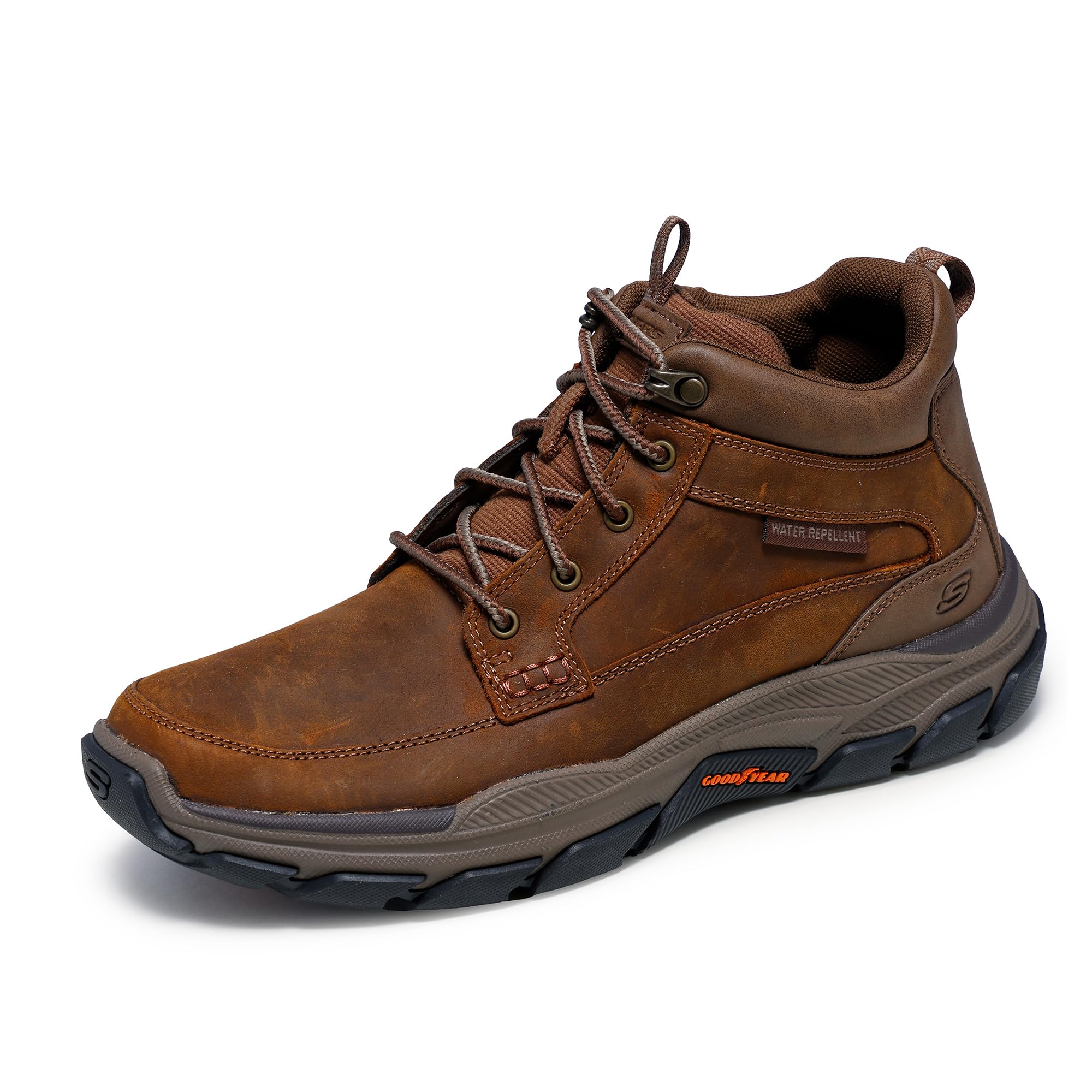
The softest, most comfortable wide-fit work boot on our list — ideal for light-duty workers or those returning from foot injury.
- Relaxed fit gives generous room through the forefoot
- Air-Cooled Memory Foam feels great from day one
- Goga Mat arch support relieves plantar pressure
- Goodyear outsole grips well on most surfaces
- Sizing runs large — size down half a size
- Not suitable for impact or compression hazards
- Mid-top offers less ankle support than 6″ boots
Skechers’ Relaxed Fit® designation isn’t just marketing — the Respected-Boswell genuinely runs wider through the toe box and forefoot than standard-fit boots. Workers with bunions or hammertoes particularly appreciate the extra room up front.
What makes these stand out: The Air-Cooled Memory Foam insole is one of the plushest we’ve tested in a work boot. Combined with the Goga Mat arch support, these boots make a significant difference for workers who suffer from heel pain or plantar fasciitis. The leather and synthetic upper adds a degree of water resistance that handles light rain and splashes well.
These are best suited for light industrial environments, service roles, retail, and hospitality rather than heavy construction. If your job involves significant impact risk, step up to a steel-toe option.

A no-fuss wide-fit steel-toe boot with waterproof protection at a price point that doesn’t break the tool budget.
- Wide fit with ASTM-rated steel toe protection
- Waterproof membrane handles rain and puddles
- Slip-resistant outsole for wet and oily surfaces
- Removable insole allows custom orthotics
- Heavier than average — noticeable on long walks
- Waterproofing can degrade in prolonged submersion
- A small number of units reported squeaking
Caterpillar’s Threshold delivers solid bang-for-buck for wide-footed workers who need safety-rated footwear without spending premium prices. The breathable leather upper holds up to daily abuse, and the removable insole is an underrated feature — it allows you to swap in custom orthotics, which can make a significant difference for workers with flat arches or high-impact jobs.
Real-world performance: The waterproof membrane performed well in our wet-surface tests, keeping feet dry through standing water up to about an inch deep. On oil-slicked floors, the slip-resistant outsole provided reliable traction. These won’t win awards for cushioning, but for the price and safety spec, they’re hard to beat in the wide-fit category.

A flexible, lightweight wide-fit boot that moves naturally with your foot — ideal for workers who cover a lot of ground daily.
- ContourWelt® technology flexes with foot movement
- Composite toe is lighter than steel, airport-friendly
- Waterproof premium leather with abrasion-resistant toe
- Slip and chemical-resistant outsole
- Feels heavier than expected for a “flexible” boot
- Laces may need significant loosening for 4E feet
- Some durability complaints after 8–10 months of heavy use
The Wolverine Overpass stands apart from the crowd thanks to ContourWelt® technology — a construction method that allows the sole to flex in sync with your natural gait rather than resisting it. For wide-footed workers who walk several miles per shift, this translates to noticeably less knee and hip fatigue over time.
Why the composite toe matters: Composite toes meet the same ASTM F2413 impact and compression ratings as steel, but are lighter, non-conductive, and won’t set off metal detectors — useful for airport security workers, government contractors, and EH-rated environments where metal-free footwear is required.
Durability is the one area where we’d flag caution: a subset of users report sole separation and upper wear after 8–10 months in high-mileage roles. If longevity is your top priority, the Wolverine Floorhand may be the more durable choice.

A soft-toe wedge boot that breaks in fast and stays breathable — the go-to choice for summer job sites and warm work environments.
- Unlined upper keeps feet significantly cooler
- Goodyear welt molds to foot shape over time
- Breaks in much faster than leather competitors
- Wedge sole provides stable platform on flat surfaces
- Laces wear out faster than the boot itself
- Sizing runs large — order half size down
- No toe protection for hazardous environments
The Wolverine Loader takes a different approach — the unlined interior dramatically improves breathability, making it one of the few work boots that stays genuinely comfortable in summer heat. The Goodyear welt construction means the boot slowly conforms to your foot’s specific shape, including wide forefoot and high instep, which becomes more noticeable after the first month of wear.
Wedge sole advantage: Unlike traditional lug soles, the flat wedge platform distributes body weight more evenly across the foot, which reduces pressure points for wide-footed workers and is preferred by carpenters, framers, and finish workers who spend time on scaffolding and elevated surfaces.
This is strictly a soft-toe boot — not appropriate for environments with falling object, compression, or electrical hazard risks. If your site requires ASTM-rated protection, choose one of the safety-toe options above.
If your current boots fit decently but you’re still experiencing foot fatigue, arch pain, or heel soreness by the end of a shift, the problem might not be the boot — it might be the insole. The stock insoles in most work boots are thin, flat, and designed to fit a range of foot shapes, which means wide-footed workers rarely get proper lateral support.

Specifically engineered for workers over 200 lbs and those with wider feet, these insoles provide reinforced arch support, heel cushioning, and even pressure distribution across the full footbed. They’re particularly effective for reducing lower back fatigue caused by prolonged standing on hard surfaces. Trim-to-fit design works with most of the boots on this list — just remove the stock insole first for the best fit.
Choosing a work boot when you have wide feet isn’t just about picking the largest size on the shelf — it requires understanding how boot construction actually accommodates foot width, what width ratings actually mean, and how different boot types suit different job requirements.
Measure at End of Day
Feet naturally swell throughout the day — up to half a size in some cases. Always measure in the afternoon or evening, and wear the same thickness socks you’ll use on the job. This prevents buying boots that feel fine in the morning but constrict by midday.
Check Toe Box Shape, Not Just Width
Width is only part of the equation. The toe box shape — round, square, or tapered — matters just as much. Wide-footed workers generally fare best with square or round toe boxes. Tapered or pointed toes will cause bunion pressure even in a “wide” size.
Break In Gradually
Even wide-fit boots need a break-in period. Start by wearing new boots for 2–3 hours on lighter days, then gradually increase. This allows the leather to soften and mold to your foot’s specific shape before long shifts. Never wear brand-new boots for a 12-hour first shift.
Match Safety Rating to Your Jobsite
OSHA requires appropriate foot protection based on hazard type. Steel toe for impact and compression, EH rating for electrical sites, metatarsal guards for extreme falling hazards. Don’t buy down on safety ratings just to find wide sizing — the right boot exists for virtually every hazard and width combination.
Lacing Technique Matters
Wide-footed workers can improve fit with the right lacing method. The “window lacing” technique (skipping an eyelet at the widest part of the foot) creates a wider pocket in the midfoot without loosening overall ankle support. This small change can eliminate forefoot pressure significantly.
Replace Insoles Every 6 Months
Insoles compress over time and lose 40–60% of their cushioning after 6 months of daily wear. For wide-footed workers who carry more weight on a broader platform, insole degradation is even faster. Budget for insole replacement as part of your annual boot maintenance rather than waiting until they feel completely flat.
When shopping for wide work boots, the width label is just the starting point. Here’s what our team evaluates across every pair we test — and what you should look for before buying.
| Feature | What to Look For | Why It Matters for Wide Feet |
|---|---|---|
| Width Sizing | EE (2E) or EEEE (4E) designation | Prevents toe squeeze and bunion rubbing across the full shift |
| Toe Box Shape | Round or square profile | Tapered toes pinch wide forefeet regardless of listed width |
| Insole Support | Contoured arch support, heel cup | Wide feet often have flatter arches needing lateral support |
| Upper Material | Full-grain leather or quality synthetic | Leather stretches and molds; synthetics offer more breathability |
| Safety Rating | ASTM F2413 for toe, EH for electrical | Safety requirements don’t change based on foot width |
| Outsole | Slip-resistant, oil-resistant rubber | Wide feet distribute weight differently — grip must accommodate |
| Waterproofing | Membrane (Gore-Tex or proprietary) | Wet leather expands less, keeping wide-fit boots from feeling tight |
| Weight | Under 2.5 lbs per boot preferred | Heavier boots amplify fatigue for workers covering long distances |
On waterproofing: There’s an underappreciated benefit to waterproof boots for wide-footed workers specifically — a proper waterproof membrane keeps leather from absorbing moisture and expanding unevenly throughout the day. Dry leather holds its shape better, meaning your boot’s fit remains consistent from morning to evening, rather than feeling looser as the day goes on.
On sole type: For workers on concrete or asphalt, a flatter wedge sole (like the Wolverine Loader) distributes pressure more evenly across a wide foot compared to an aggressive lug sole. For outdoor terrain, a deeper lug pattern provides better grip. Match your sole to your primary surface.
Our top-rated picks are the Wolverine Floorhand (best overall), Timberland PRO Pit Boss (best steel-toe), and the Skechers Respected-Boswell (best comfort). For extra-wide (4E) feet specifically, Wolverine and New Balance offer the most consistent sizing across their wide-fit lines.
KEEN Utility is well-known for their naturally roomy toe box design across their entire line. Timberland PRO, Wolverine, and New Balance all offer dedicated wide and extra-wide sizing. Caterpillar’s Threshold line also accommodates wider feet well in the steel-toe category.
Measure both feet (in the afternoon, when feet are at their largest) on a Brannock device or printable foot chart. Note your length and width separately. Compare both measurements against the specific brand’s sizing chart — sizing varies between manufacturers. Read verified customer reviews that specifically mention fit, as they’re often more reliable than listed specs alone.
Yes — New Balance’s Industrial line offers some of the best 4E wide work boots available, with strong cushioning and safety ratings. Wolverine’s extra-wide options in the Floorhand and Overpass series also come highly rated for 4E comfort. Both brands use lasts that genuinely accommodate wider foot shapes rather than simply widening a standard boot.
Yes, and we strongly recommend it for wide-footed workers with arch pain or plantar fasciitis. Most of the boots on our list have removable stock insoles. Replace them with a wide-width orthotic or a contoured insole like the Dr. Scholl’s Heavy Duty option. Note that adding a thicker insole slightly reduces internal volume — if your boots already feel snug, consider going half a size up before adding aftermarket insoles.
The Timberland PRO Pit Boss is our top recommendation for this combination — it has one of the widest steel-toe designs we’ve tested and meets ASTM F2413 impact, compression, and EH standards. The CAT Threshold is a strong budget alternative that doesn’t sacrifice safety ratings for the price.
Xero Shoes and Vivobarefoot both produce wide, zero-drop work footwear that closely mimics barefoot movement. These are flexible, lightweight, and allow your foot to splay naturally. However, they offer limited safety certifications compared to traditional work boots — verify they meet your jobsite’s PPE requirements before purchasing.
💡 Final Thoughts
Wide feet and work boots don’t have to be a difficult combination. The market has improved significantly, and today’s top picks offer genuine wide sizing — not just a slightly stretched standard boot — alongside the safety features and durability that demanding jobs require.
Our top recommendation remains the Wolverine Floorhand for most workers: it’s waterproof, well-cushioned, and available in true wide sizing that accommodates broad forefoot shapes without sacrificing ankle support or durability. For steel-toe requirements, the Timberland PRO Pit Boss is the strongest wide-fit safety boot we’ve tested.
Whatever boot you choose, pair it with a quality wide-fit insole, break it in gradually, and replace insoles every 6 months. Your feet carry you through every shift — give them the room and support they deserve.